
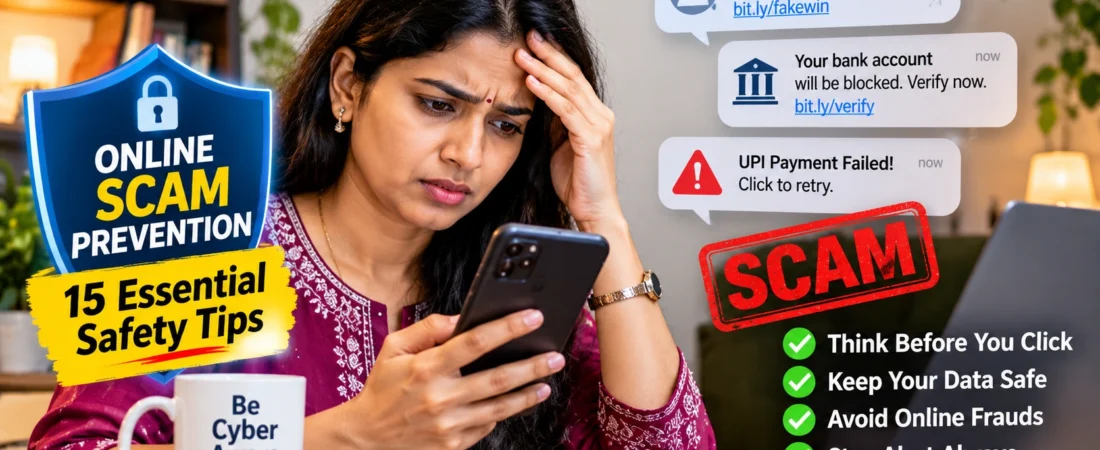
Online scams in India are becoming increasingly sophisticated. From fraudulent UPI payment requests and fake bank calls to digital arrest threats, phishing links and investment schemes, cybercriminals are constantly finding new ways to exploit people’s trust and steal their money or personal information.
A message claiming that your bank account will be blocked, a phone call from someone pretending to be a police officer, or a WhatsApp offer promising easy income can appear convincing. In many cases, scammers deliberately create panic or excitement so that victims act before checking whether the communication is genuine.
The good news is that many online scams can be prevented through a few practical security habits. Knowing how to recognise suspicious messages, protect banking credentials, verify payment requests and report cybercrime can significantly reduce your exposure to fraud.
This guide explains how to protect yourself from online scams in India, identifies 15 essential safety practices and explains what to do if you or someone in your family becomes a victim of cyber fraud.
What Are Online Scams?
Online scams are fraudulent activities carried out through the internet, mobile phones, digital payment applications, social media platforms, emails or messaging services. Scammers impersonate trusted individuals or organisations to trick people into revealing confidential information, installing malicious applications or transferring money.
These scams may target anyone, regardless of age, education, profession or financial background.
Some fraudsters focus on stealing banking credentials, while others use fake employment opportunities, investment advertisements, shopping websites or emotional manipulation to gain access to victims’ money.
According to the Indian Computer Emergency Response Team (CERT-In), common online threats include phishing, job fraud, investment scams, fake technical support, digital arrest scams and fraudulent online shopping schemes.
15 Essential Safety Tips to Protect Yourself from Online Scams in India
1. Never Share Your OTP, UPI PIN or Banking Password
One of the simplest ways to protect your money is to keep your banking credentials private.
An OTP (One-Time Password) is used to authenticate certain transactions and account-related activities. Your UPI PIN authorises payments from your linked bank account.
Scammers may pretend to be bank employees, customer-care representatives, delivery agents or government officials and ask you to share these details.
Remember:
- Never share your OTP with anyone.
- Never disclose your UPI PIN, ATM PIN or internet banking password.
- Do not share card CVV numbers or confidential banking information over calls or messages.
- Avoid entering banking credentials on websites received through unsolicited links.
Legitimate bank employees do not need your OTP or UPI PIN to provide routine customer support.
2. Be Careful While Making UPI Payments
UPI has made digital payments convenient, but scammers frequently exploit users’ unfamiliarity with payment requests and QR codes.
A common trick involves sending a QR code with a message claiming that scanning it will help you receive money.
However, scanning a payment QR code and entering your UPI PIN generally authorises a payment from your account. You do not need to enter your UPI PIN simply to receive money.
Before approving any transaction:
- Check the recipient’s name displayed in your UPI application.
- Confirm the amount before entering your PIN.
- Reject unexpected collect requests.
- Never approve a payment request just because someone claims to be sending you money.
- Do not scan unfamiliar QR codes without understanding the transaction.
For additional guidance, visit the National Payments Corporation of India’s (NPCI) Fraud Awareness Centre.
3. Avoid Clicking on Unknown Links
Phishing is a technique in which scammers send fraudulent links designed to steal passwords, financial information or personal details.
You may receive messages such as:
- Your bank account will be blocked today.
- Your electricity connection will be disconnected.
- Your KYC verification is incomplete.
- Your parcel is waiting for delivery confirmation.
- You have won a cash reward. Claim it immediately.
These messages often contain links to fake websites that imitate legitimate organisations.
Before clicking any link, check the sender and destination carefully. When a message claims to come from your bank or a government department, visit the official website independently rather than following the supplied link.
An HTTPS connection alone does not prove that a website is genuine.
4. Protect Yourself from Digital Arrest Scams
Digital arrest scams have become a particularly frightening form of cyber fraud.
In these cases, scammers impersonate police officers, CBI officials, customs officers or other law-enforcement personnel. They may claim that your Aadhaar number, bank account or mobile number has been connected to criminal activity.
Victims are sometimes kept on prolonged video calls and told that they cannot leave the conversation while an investigation is underway.
The fraudsters may demand money under the pretext of verification, security deposits or clearing the victim’s name.
How to stay safe:
- Do not panic when someone threatens immediate arrest over a video call.
- Never transfer money to prove your innocence.
- Do not share Aadhaar details, banking information or OTPs.
- Do not follow instructions to remain isolated or continuously monitored on a call.
- Independently contact the relevant law-enforcement agency through its official channels.
Remember that a video call does not establish someone’s official identity. CERT-In specifically advises people not to transfer money under pressure from individuals claiming to represent law-enforcement agencies.
5. Verify Job Offers Before Sharing Personal Information
Fake recruitment offers are a common risk for students, fresh graduates and experienced professionals.
Scammers may impersonate well-known companies, recruitment agencies or HR managers. They sometimes advertise attractive salaries and promise immediate selection without a proper interview.
After gaining the applicant’s trust, they demand money for:
- Registration.
- Interview scheduling.
- Background verification.
- Training materials.
- Offer-letter processing.
- Security deposits.
Be cautious whenever an employer or recruiter demands payment to secure a job.
Check the vacancy on the company’s official careers page, verify the recruiter’s professional identity and contact the organisation through independently verified details.
Do not share identity documents, banking information or other sensitive details with unverified recruiters.
6. Download Applications Only from Trusted Sources
Fraudulent mobile applications can be used to steal personal information, monitor activity or gain unauthorised access to devices.
A scammer may send an APK file through WhatsApp or ask you to install an application to complete KYC verification, receive a refund or obtain technical assistance.
Some malicious applications can request excessive permissions or enable remote access.
To reduce the risk:
- Download applications from official app stores.
- Check the developer’s identity and application reviews.
- Review permissions before installation.
- Avoid installing APK files from unknown sources.
- Keep your phone’s operating system and applications updated.
- Remove applications you no longer use.
Never install remote-access or screen-sharing applications at the request of an unsolicited caller claiming to be from your bank or technical support team.
7. Do Not Trust Unknown Customer-Care Numbers
One common mistake people make is searching for customer-care numbers through search engines or social media without verifying the results.
Fraudsters sometimes publish fake helpline numbers that appear alongside genuine business listings.
When someone calls such a number, the person answering may pretend to be a bank representative, online shopping executive or payment service employee.
Instead:
- Use the customer-care details listed on the organisation’s official website or application.
- Avoid numbers posted randomly in social media comments.
- Never share OTPs or banking passwords during customer-support calls.
- Do not install applications suggested by unknown customer-care representatives.
For banking complaints, use the contact details provided by your bank.
8. Be Cautious of Work-from-Home and Part-Time Job Scams
Work-from-home opportunities are attractive to students, homemakers, job seekers and professionals looking for additional income.
Unfortunately, scammers exploit this demand through fake data-entry jobs, online rating tasks, product-review assignments and Telegram-based earning schemes.
A typical scam begins with a small payment to establish trust. The victim is then encouraged to invest larger amounts to unlock higher-paying tasks or withdraw supposed earnings.
Eventually, the scammer stops responding or demands additional payments.
Before accepting an online job:
- Verify the company and its official website.
- Ask for a written job description.
- Check whether the recruiter uses an authentic company email address.
- Avoid opportunities promising unrealistic returns for minimal work.
- Never transfer money to unlock your salary or withdraw earnings.
A genuine employment opportunity should not require you to deposit money into an unknown personal account to receive your wages.
9. Secure Your Social Media Accounts
Social media accounts contain personal photographs, contact details, conversations and other information that scammers can exploit.
Fraudsters may create duplicate profiles using someone’s photographs and then contact their friends or relatives to request emergency financial assistance.
Others may hack existing accounts and send fraudulent links to followers.
Protect your accounts by:
- Using strong, unique passwords.
- Enabling two-factor authentication.
- Keeping your recovery email and phone number updated.
- Reviewing active login sessions.
- Avoiding suspicious third-party applications.
- Restricting access to personal information.
- Verifying unusual money requests through a direct phone call.
If a friend suddenly asks for money through WhatsApp or Instagram, contact that person separately before transferring anything.
10. Avoid Suspicious Investment and Trading Schemes
Investment scams often promise unusually high returns with little or no risk.
Fraudsters may advertise cryptocurrency investments, stock market tips, trading groups, online wealth programmes or exclusive investment opportunities.
Some schemes use fabricated screenshots showing large profits to convince people that others are earning money.
Warning signs include:
- Guaranteed returns.
- Pressure to invest immediately.
- Unregistered investment advisers.
- Payments requested to personal bank accounts.
- Fake trading dashboards.
- Difficulty withdrawing your investment.
- Additional fees demanded before releasing profits.
Before investing, independently verify the company, adviser and relevant regulatory registration.
For securities-market-related activities, consult the official SEBI website.
Never make an investment decision solely because someone in a WhatsApp or Telegram group claims to have earned substantial profits.
11. Check Websites Before Shopping Online
Fake shopping websites sometimes advertise branded products at unusually low prices to attract customers.
After receiving payment, the seller may disappear, deliver counterfeit products or send something completely different from what was advertised.
Before placing an order:
- Check the website’s domain carefully.
- Look for genuine business contact information.
- Read independent customer reviews.
- Review the return and refund policy.
- Avoid transferring money to unfamiliar personal UPI IDs.
- Be cautious of unrealistic discounts and countdown offers.
Whenever possible, use established marketplaces and secure payment methods.
Remember that a professional-looking website does not automatically mean the seller is trustworthy.
12. Never Share Your Screen with Unknown People
Screen-sharing applications can allow another person to view sensitive information displayed on your device.
Scammers may ask you to share your screen to resolve a banking issue, process a refund or verify an account.
During the process, they may observe OTPs, payment notifications, passwords or other confidential information.
Never provide screen access to an unknown caller.
If you need technical support, contact the service provider independently and use its verified support channels.
13. Protect Your Aadhaar and Other Identity Documents
Personal identity information can be misused for impersonation, fraudulent account applications and other forms of identity theft.
Avoid sharing photographs of your Aadhaar card, PAN card, passport or other identity documents without a legitimate reason.
Useful precautions include:
- Use Masked Aadhaar where accepted and appropriate.
- Never publish identity documents on social media.
- Avoid sending sensitive documents to unverified WhatsApp numbers.
- Do not share Aadhaar OTPs with unknown callers.
- Check your financial accounts for unfamiliar activity.
- Use official UIDAI services to manage Aadhaar-related security settings.
You can visit the UIDAI official website for Aadhaar-related services and guidance.
14. Use Secure Internet Connections and Strong Passwords
Public Wi-Fi networks at railway stations, airports, cafes and shopping centres can expose users to security risks, particularly when networks are impersonated or poorly secured.
Avoid accessing sensitive banking services through unfamiliar public networks.
Additional precautions include:
- Use mobile data or a trusted Wi-Fi network for financial transactions.
- Create different passwords for important accounts.
- Use a reputable password manager if necessary.
- Enable multi-factor authentication wherever available.
- Lock your phone with a PIN, password or biometric security.
- Keep your browser and operating system updated.
A password that is reused across multiple websites can create a serious security problem. If one service is compromised, attackers may attempt to use the same credentials elsewhere.
15. Report Suspicious Calls, Messages and Financial Fraud Immediately
Recognising a scam is useful, but reporting it is equally important.
India provides official channels for reporting suspected fraud communications and cybercrime.
If you receive a suspicious call or message, you can report it through the Department of Telecommunications’ Sanchar Saathi Chakshu facility.
If money has already been lost or you have become a victim of cybercrime, contact the national cybercrime helpline immediately.
Keep screenshots, transaction IDs, bank messages, phone numbers and other relevant evidence.
Do not delete conversations or payment records that may help investigators.
Common Types of Online Scams in India You Should Recognise
Understanding the different ways scammers operate can help you identify warning signs before losing money.
| Type of scam | How it works | Warning sign |
|---|---|---|
| UPI fraud | Fake payment requests or QR-code tricks | Request to enter UPI PIN to receive money |
| Phishing | Fake websites and messages steal credentials | Urgent links asking for account details |
| Digital arrest | Criminals impersonate law-enforcement officials | Threats and demands for money |
| Job fraud | Fake recruiters demand fees | Payment required for employment |
| Investment fraud | Fake schemes promise high returns | Guaranteed profits |
| KYC fraud | Fake bank messages request account updates | Unknown links asking for personal details |
| Customer-care fraud | Fake helpline numbers impersonate companies | Unverified support representatives |
| Social media fraud | Duplicate or compromised accounts request money | Unusual emergency payment requests |
| Loan app fraud | Fake lenders collect fees or sensitive information | Upfront charges and excessive permissions |
| Delivery fraud | Fake delivery messages request payment or personal details | Unexpected payment links |
What Should You Do If You Become a Victim of an Online Scam in India?
Even careful internet users can become victims of fraud. Scammers often use sophisticated impersonation techniques and psychological pressure.
If you discover that money has been stolen or your financial information has been compromised, act immediately.
Step 1: Call the Cybercrime Helpline 1930
If you have lost money through online financial fraud, immediately call 1930, India’s national cybercrime helpline.
Provide the relevant transaction details and information requested by the helpline.
Reporting quickly can help authorities and participating financial institutions take action, although recovery is not guaranteed.
Step 2: File a Complaint on the National Cyber Crime Reporting Portal
Visit the official National Cyber Crime Reporting Portal.
Choose the appropriate reporting option and provide accurate details.
Keep the acknowledgement or complaint reference number for future follow-up.
Step 3: Contact Your Bank Immediately
Inform your bank about the fraudulent transaction.
Request that the bank take appropriate action to secure your account and investigate the transaction.
Depending on the situation, you may need to:
- Block your debit or credit card.
- Disable UPI transactions temporarily.
- Reset your internet banking credentials.
- Secure your registered mobile number and email account.
- Report unauthorised transactions through the bank’s official grievance channel.
Step 4: Preserve Digital Evidence
Keep the following information ready:
- Transaction ID or UTR number.
- Date and time of the transaction.
- Amount transferred.
- Bank account details.
- Suspected phone numbers.
- WhatsApp or SMS conversations.
- Screenshots of fraudulent websites.
- Emails and payment receipts.
This information can help the bank and law-enforcement authorities investigate the complaint.
Step 5: Report Suspicious Calls and Messages Through Chakshu
The Department of Telecommunications provides the Chakshu facility through Sanchar Saathi.
It allows users to report suspected fraudulent communications received through calls, SMS or WhatsApp.
Visit Sanchar Saathi – Chakshu.
As specified in the RBI’s guidance, suspected fraud communications received within the preceding 30 days can be reported through this facility.
Important: Chakshu is intended for reporting suspected communications. If money has already been lost, use the 1930 helpline and National Cyber Crime Reporting Portal as well.
Important Government Websites and Helplines for Cyber Safety in India
Knowing the correct official reporting channels can save valuable time during an emergency.
| Service | Purpose | Official channel |
|---|---|---|
| National Cybercrime Helpline | Report financial cyber fraud | 1930 |
| National Cyber Crime Reporting Portal | File cybercrime complaints | cybercrime.gov.in |
| Sanchar Saathi Chakshu | Report suspicious calls and messages | sancharsaathi.gov.in |
| CERT-In | Cybersecurity advisories and incident reporting information | cert-in.org.in |
| UIDAI | Aadhaar-related services and security information | uidai.gov.in |
| RBI | Banking and financial consumer information | rbi.org.in |
| NPCI | UPI and digital payment fraud awareness | npci.org.in |
Why Are Senior Citizens and First-Time Internet Users Particularly Vulnerable?
Online fraud does not affect every person in the same way.
Senior citizens may receive calls from individuals pretending to be bank officials, police officers or government representatives. Some scammers deliberately use intimidating language to make older people feel frightened or confused.
First-time digital payment users may also be unfamiliar with UPI collect requests, QR codes, online banking procedures and suspicious application permissions.
Families can reduce these risks by encouraging open conversations about online safety.
A few useful steps include:
- Help older family members identify official banking applications.
- Explain why OTPs and UPI PINs must remain confidential.
- Teach them how to reject unknown payment requests.
- Save verified bank and emergency contact numbers.
- Encourage them to call a family member before making an unfamiliar payment.
- Explain common digital arrest and investment scams.
Cybersecurity awareness should be treated as a shared family responsibility rather than something only technology professionals need to understand.
Frequently Asked Questions About Online Scams in India
1. What is the cybercrime helpline number in India?
The national cybercrime helpline number in India is 1930. It is particularly important for reporting financial cyber fraud. Victims should also register a complaint through the National Cyber Crime Reporting Portal.
2. How can I report an online scam in India?
Visit cybercrime.gov.in and select the appropriate complaint category. If you have lost money, call 1930 immediately. Preserve transaction details and other digital evidence.
3. Can someone steal money through a UPI ID?
A UPI ID alone does not automatically allow someone to withdraw money from your bank account. However, scammers can use it as part of social-engineering attempts to trick you into authorising payments or disclosing confidential information.
4. Can I receive money through UPI without entering my PIN?
Yes. You generally do not need to enter your UPI PIN to receive money. Entering your PIN authorises a payment or another authenticated transaction, so always read the payment screen carefully.
5. What should I do if I accidentally shared my OTP?
Contact your bank immediately if the OTP was related to banking or payment activity. Secure the affected account, change compromised credentials where applicable, review recent transactions and report any unauthorised activity through 1930 and the cybercrime portal.
6. Are digital arrest calls genuine?
A caller claiming to place you under digital arrest and demanding money to avoid legal action is displaying a major fraud warning sign. Do not transfer money or share sensitive information. Verify any claimed investigation independently through official authorities.
7. How can I identify a fake online shopping website?
Check the domain name, business details, return policy, independent reviews and payment options. Be especially cautious about unrealistic discounts and requests to transfer money to unfamiliar personal accounts.
8. Can I report a scam if I have not lost money?
Yes. You can report suspected fraudulent calls and messages through the Chakshu facility on Sanchar Saathi. You can also report cybercrime-related incidents through the appropriate channels.
9. Does reporting cyber fraud guarantee a refund?
No. Reporting quickly can help authorities and financial institutions attempt to trace or restrict fraudulent transactions, but a refund is not guaranteed. The outcome depends on the circumstances, transaction status and investigation.
10. How can I protect my family from online scams?
Discuss common fraud techniques with family members, enable two-factor authentication, use strong passwords, verify unusual payment requests and encourage everyone to contact trusted family members before making unfamiliar financial transactions.
Conclusion: Stay Alert, Think Before You Click and Protect Your Money
Online scams in India are not limited to people who are unfamiliar with technology. Anyone can become a target when fraudsters use fear, urgency, attractive offers or impersonation to manipulate their decisions.
The most effective protection begins with simple habits: never share your OTP or UPI PIN, verify payment requests, avoid suspicious links, download applications from trusted sources and independently confirm unusual financial demands.
If you or someone you know becomes a victim of cyber fraud, act immediately. Call 1930, inform your bank and register a complaint through the National Cyber Crime Reporting Portal.
A few seconds spent verifying a message or payment request can prevent a much bigger financial loss.
Stay informed, stay cautious and help your family build safer digital habits.